Unveiling the Truth about Rent Control and Land Values in Housing

Featured

Further analysis of where Vicky didn’t go!

A great interview with Housing journalist and author

My comments on the interview and replies to other’s comments are in parts two and three.

I’ve been researching housing unaffordability for seven years and am about to start writing a dissertation on Rent Control (℅ Dr Anna Minton). After all these years of trying to find solutions, the elephant in the room is Rent Control. Why?

This is a disappointing and slightly dull answer, but it’s one of the keys that has unlocked many doors for working—and middle-class people who don’t want to spend 30-50% of their income on a 40-year mortgage or rent to a landlord.

Some of the main authors to thank for this conclusion are John Doling (tries to be neutral), Danny Dorling (left), Nick Bano (left), Kemp (right), and Christine Whitehead (LSE, right). It is always good to see if there is a counter-argument of value—there isn’t.
(As well as Smith, Ricardo, Marx, Keynes, Piketty, Blyth, Mazzucato, Christophers, Kelton, Richard Murry and Minton)

Her Book, Tenants

Why? An example: I’m a former bricklayer who ran a business in construction, so I know about house building pricing. My humble little flat;
In 1994, it was purchased for £47,700 with a floor area of 42m². In 1994, it cost £600 per m² to build, thus £25,200 to rebuild. Therefore, 53% build/47% land value = £47,700.

The killer point: in the 1950s, land values of new builds dropped to 3%. Based on those values and present-day build values (£2K per/m²), my flat would be on the market for £86,600, which equates to 2.4 times the full-time national average income (£35K). 2.4 times was also needed in the 1950s-60s for a single average income to buy an average 2.5-bed semi (.5 being the box room).


Ref; The Housing Crisis is Even Worse Than You Think | Aaron Bastani meets Vicky Spratt | Downstream

At present I’m working on a paper that will be finished by the 26th of April, once completed I will write a timeline for the Video filling in the areas that some may want more information on. As well as the Buy-To-Let Quetion that was left unanswered.

Post 26th I’ll have more info as the area I’m working on is the periods of; 1930-42, 1945-70, followed by 1979 to the present concerning universalist approach to housing/welfare until 1979 then the selectivist approach to housing/welfare.

Keynes; The role of Government is to create a society where all can have the opportunity to have a ‘good life’ and not just the few.

Joining the dots

On the 4th of November I had a lecture on Neoliberalism, a term that I have a rough grasp as to its meaning as we all live in a neoliberal world in most of the northern hemisphere, this is the present ‘normative common sense’ of our economy and social individualistic aspirations.

A really great and thorough lecture with angles that i had not seen before and thus consequences.

Knowing how well researched and read Anna Minton is it was rather depressing to hear her admit that to a point that the concepts of the ‘reclaiming the commons’ had fizzled out. Yet as Mark ( PhD student attending the class who is working on voluntary housing schemes) commented there are projects on the go in the country, but had to admit the enthusiasm of the recent past has declined.
Bumped into a paper this morning reinforcing this depressing reality (see further below for an abstract);

https://www.academia.edu/24685147/The_Rise_and_Fall_of_Social_Capital_Requiem_for_a_Theory?email_work_card=view-paper

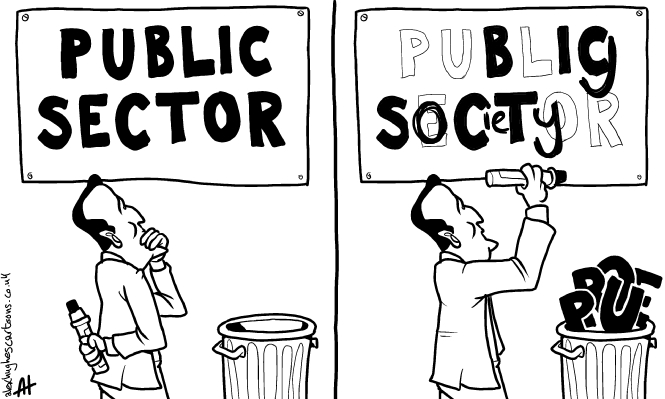
Blair’s ‘Third Way and Cameron’s ‘Big Society’ both tried (and failed) to tap into our former natural egalitarian sense of societal values (Henrich 2021) that are a disconnect from the baseline of Neoliberal thought, that as Hayek would say that at our core we are all ‘self seeking’ and therefore the only real value is monetary and thus we all should work and accept this value, and the invisible hand of the market will solve all our woes if we just give it time (recently completely dismantled by ‘trussanomiocs’).


The reason the Big Society almost instantly failed was that it’s such a contradiction to the common sense that we the public had been taught/indoctrinated for the past 40 years (1979-2010), namely; ‘there is no such thing as society’ every man woman and child for themselves, along with the suspicion we were being taken for fools, expected to work for nothing to support the bottom end of society whist the wealthy yet again ,’run off with the money’. A London East End term would be, to be ‘Mugged off’.


This is the classic ‘all actions have a reaction’ reality, you prime a population to become hyper individualistic, to follow ‘their ‘ dreams, add to the mix ‘positivity’ ie, you can do this! with a sprinkling of status aspiration and boosterism ( no negativity even with obvious failures, think Boris Johnson former PM who promoted Brexit for his own gain and could never understand the criticism as to why it failed, and it has ref -4% growth compared with those in the EU) and you have a citizen that relies on ‘feelings’ more than reality. Perfect politician and media fodder for manipulation and denial of uncomfortable facts ( ie Michael Gove; ‘we no longer need experts’).

The term from an academic perspective is ‘social capital theory’, where we take what we have to offer as individuals with others and collectively do something for the benefit of society/community and not necessarily for monetary profit, ie ‘the big society’.