Chapter One
What is money?
Money is a record of debt.
Money is an accounting system for debt and its cancellation.
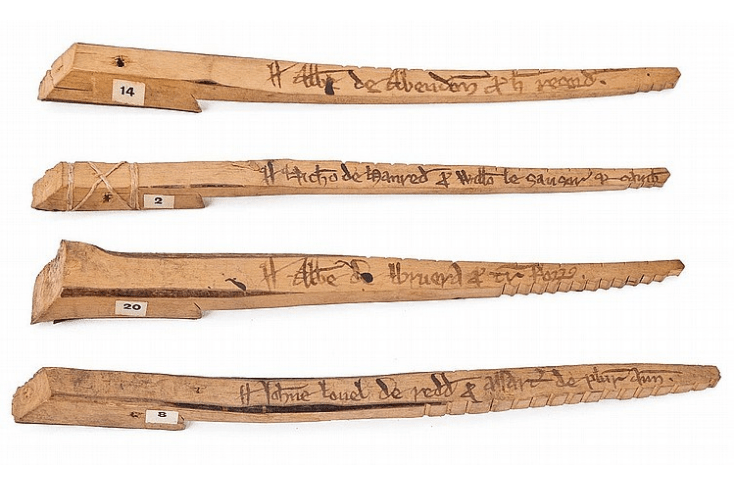
A skilled person performs a task for a day for a farmer whose crop has yet to grow, and records that day in a ledger (a mark in clay and a notch on a stick, often known as ‘tally sticks’).
Until the crop reaches maturity, the Farmer is indebted to the tradesperson by one day, which is recorded on a tally stick. Both have a copy. When the debt is repaid, for example, via some of the harvested crops, then both the debt and the credit are destroyed, and the debt on one side and the credit on the other no longer exist. They have cancelled each other out.
Later, these tally sticks could be exchanged for others as long as the debt’s original issuer was known.
This is all based on the trust that the debt will be honoured.
Thus, as societies grew, a centralised system of record-keeping and trust had to be established, as corruption and lies could undermine the honouring of debts. The central government had to be able to enforce the honouring of debts and, in turn, needed universally recognised tokens/sticks/paper/stamped metals that had no literal value or rarity but of trust; this is what is known as a fiat-based currency (fiat means ‘by decree’)
As the issuer, how could they create value so the government could exchange their issued currency for labour and products?
Tax with a punishment if it is not paid when demanded by the issuing government; the most basic punishment is the denial of freedom, i.e., prison.
To help us understand this, the economist Warren Mossler (WM) came up with a scenario;

You’re in a dance hall, and WM approaches you with a business card and asks you to work behind the bar for 20 minutes in exchange for the card.
You reply, ” Why should I? It has no value, and I cannot exchange it for a drink or anything”.
WM replies: There is one exit door from this hall, and behind that door is a huge doorman who will not let you out unless you have one of these cards.
Now the card has value, the freedom to leave
That is the power of taxation via a larger body of governance
You work behind the bar, you get the business card, you give it to the doorman, he lets you out, and he destroys the card as the transaction has been completed.
20 minutes behind the bar for WM in exchange for the freedom to leave.
WM can create as many business cards as he likes. The value is not the card but the debt and credit to three parties.
1) To have your freedom, you are indebted to WM in exchange for 20 minutes of labour
2) You cancel that debt by working 20 minutes in exchange for the business card. That value is now in your ownership of that card
3) The WM doorman knows you haven’t paid your 20-minute debt unless you give him this card, not somebody else’s. If you have a card, the debt has been cancelled, and he tears it up because the agreement has been fulfilled.
So, to pay your tax, you must use the government-issued currency. I cannot pay UK tax in US dollars, nor can I pay US tax in UK pounds.


Pingback: Impact of Rent Control on Land Values: A Critical Analysis | It's about people, stupid…