Chapter Two
What about ‘The National Debt’?
The government creates money (debt tokens) out of nothing in exchange for us to do stuff.
That can be, for example, building a road.
The government wants a good road built between two villages to help people trade with each other. It issues a decree for money to be created to pay x workers to build a road, pay all the suppliers, and enable the builders to buy food, clothing, and shelter for themselves and their families.
As mentioned above, the government takes back some of the money as tax to keep the value of the issued money. In return, the government gets a road built, and various people use the debt token money in exchange for other outlying support for the road builders. A percentage of the money is now in the economy, and throughout the economy, as it is exchanged, other people return a certain amount in tax to the government.
The debt token is destroyed whenever Tax is paid, as the agreement has been fulfilled (remember the doorman in chapter one).
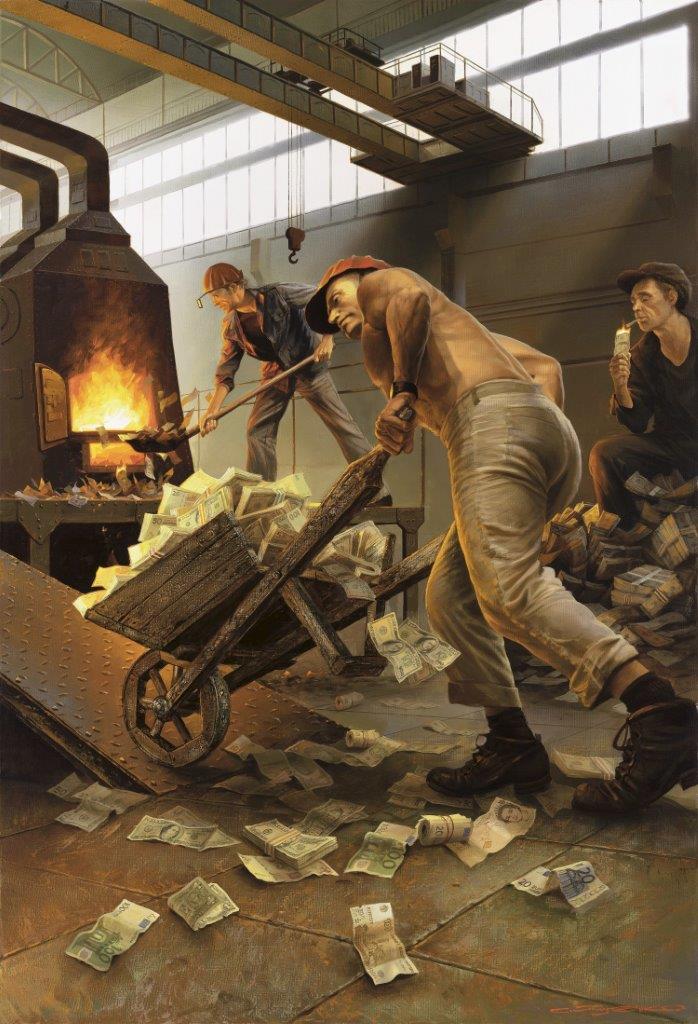
So, for example, when the government issues £100 to you in exchange for some product or labour, it shows -£100 and on your side, +£100. If then you pay a tax of £30, it will now show
a) Government side, -£100 + £30 = -£70
b) On your side +£100 – £30 = +£70
Add both together, and you get zero in double-entry accounts. The two sides should always add up to zero; if they don’t, there is a mistake.
| Government Side | Your Side | |
|---|---|---|
| Initial | -£100 | +£100 |
| After Tax Payment | -£100 + £30 | +£100 – £30 |
| Final | -£70 | +£70 |
If the government can create infinite amounts of money out of thin air, then it cannot be in debt to itself.
The government’s ‘debt’ is just all the money ever issued into the economy. Taxes have never paid for anything. It just takes money from the economy (us) and returns some of it to the government, thus reducing a minus figure on the government side and a plus figure on our side. The returned money is destroyed as the debt has been honoured.
If we paid off the government ‘debt’ (our surplus) to zero, we would have no money, and the economy would no longer exist. Remember, the two sides of the ledger always add up to zero.
 It's about people, stupid...
Pingback: Impact of Rent Control on Land Values: A Critical Analysis | It's about people, stupid…