Unveiling the Truth about Rent Control and Land Values in Housing

Featured

Further analysis of where Vicky didn’t go!

A great interview with Housing journalist and author

My comments on the interview and replies to other’s comments are in parts two and three.

I’ve been researching housing unaffordability for seven years and am about to start writing a dissertation on Rent Control (℅ Dr Anna Minton). After all these years of trying to find solutions, the elephant in the room is Rent Control. Why?

This is a disappointing and slightly dull answer, but it’s one of the keys that has unlocked many doors for working—and middle-class people who don’t want to spend 30-50% of their income on a 40-year mortgage or rent to a landlord.

Some of the main authors to thank for this conclusion are John Doling (tries to be neutral), Danny Dorling (left), Nick Bano (left), Kemp (right), and Christine Whitehead (LSE, right). It is always good to see if there is a counter-argument of value—there isn’t.
(As well as Smith, Ricardo, Marx, Keynes, Piketty, Blyth, Mazzucato, Christophers, Kelton, Richard Murry and Minton)
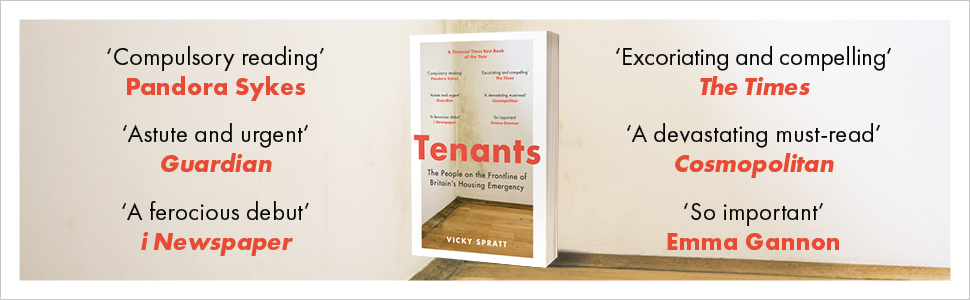
Her Book, Tenants

Why? An example: I’m a former bricklayer who ran a business in construction, so I know about house building pricing. My humble little flat;
In 1994, it was purchased for £47,700 with a floor area of 42m². In 1994, it cost £600 per m² to build, thus £25,200 to rebuild. Therefore, 53% build/47% land value = £47,700.

The killer point: in the 1950s, land values of new builds dropped to 3%. Based on those values and present-day build values (£2K per/m²), my flat would be on the market for £86,600, which equates to 2.4 times the full-time national average income (£35K). 2.4 times was also needed in the 1950s-60s for a single average income to buy an average 2.5-bed semi (.5 being the box room).
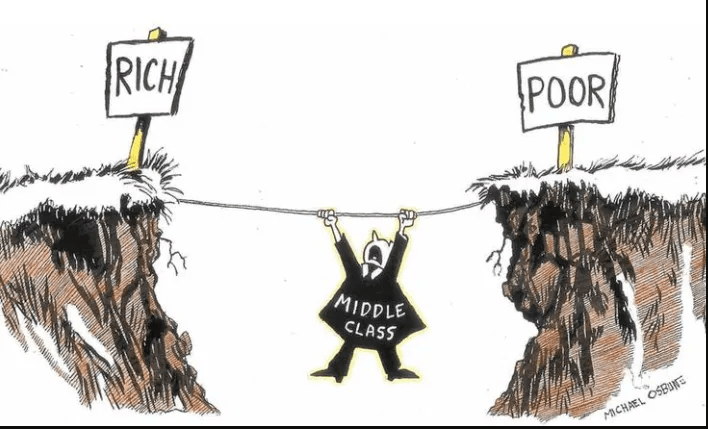
The Silent Middle Class

Why the silence in 2023?

Introduction

This post starts with summer background research on the middle class, which helps evaluate the primary content with this newfound knowledge. Then, an obscure, seemingly unrelated programme from Radio 4 that, when deconstructed, goes to the heart of the present denialism by the middle class concerning housing.
The post finishes with broad conclusions leading to further research for workable solutions or just waiting for another bloody war/revolution circa 1914-1945.

Summer reading and prelim for context

Summer reading consisted of subjects as diverse as the History of the Welfare State from 1800 to the Present, Comparative Housing Policy Across Europe and North America, and various criticisms of the supposed ‘Science’ of Economics by various heavyweights in the same field and some books on Agency and Meritocracy, just to add to the mix!

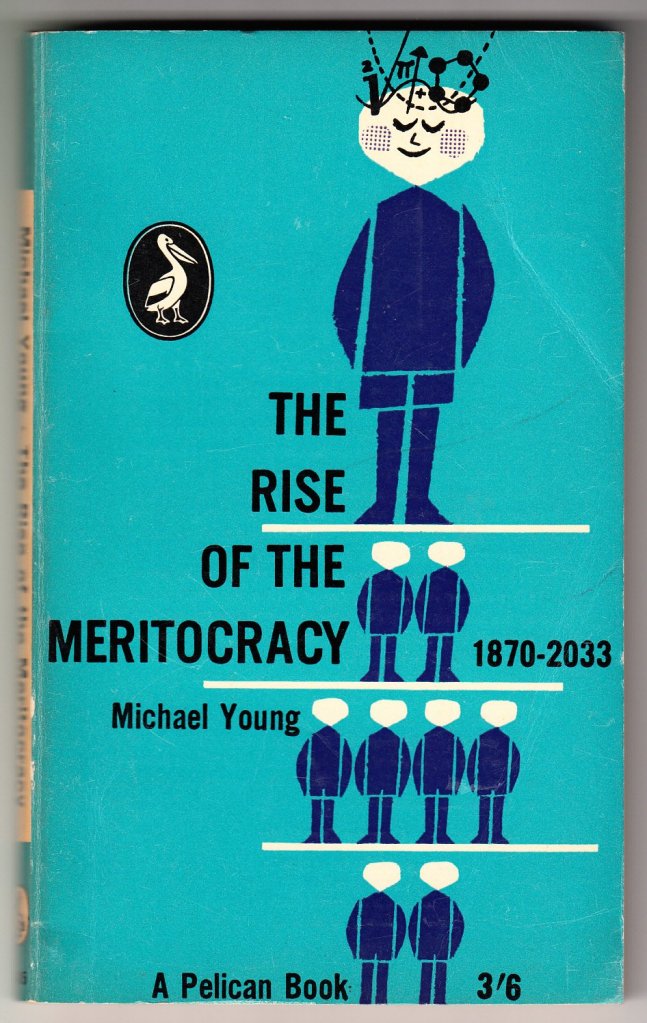
The original dystopian novel that shows the end game of meritocracy, written by the brilliant sociologist Michael Young in 1958, alas this book is sadly out of print.

What has been interesting is the various author’s interpretations of the same historical facts from different political ideologies and philosophical approaches, along with some quoting academics and the great philosophers who were locked within their lived experiences whilst other writers took a broader look from afar with present hindsight and intellectual norms to judge past reactions to circumstance and the cumulative effects of past decisions. Both are valid, though the former can seem more ideological and the latter more self-critical.

I also attended a series of lectures on the British Class System at Cambridge University, with more international post-doctoral students than you could throw a stick at; all shared their thoughts with grace and humility. Their input resulted in some fascinating insights and perceptions of the class system that I wasn’t aware of.
The weekend of lectures and discussion concluded that class is way more fluid and depends a lot on the definitions and parameters used within the time/place as a framework to make judgments. The perception of the British to class is much more nuanced than the US structure of the wealth-based class system, as proven by the comments from the US contingent in the lectures.

View from Madingly Hall, Cambridge.

Exploring the Multiverse of Decisions: A Review of ‘Everything, Everywhere All at Once”

A surreal journey through a multiverse of decisions made by one character, reflecting on the concept of co-existing multiverses in different places and times.

The Movie

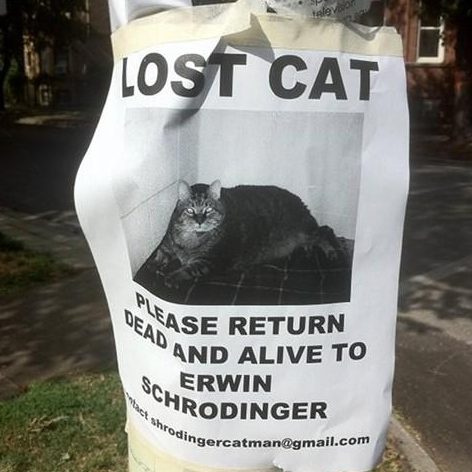
The movie “Everything, Everything All at Once” is definitely surreal in its format, jumping all over the place to communicate the idea of the multiverse of decisions made throughout one’s life. This movie focuses on one character’s journey; each individual since the beginning of time itself has a unique multiverse of decisions and consequences, according to quantum theory of co-existing multiverses in different places and times, but are only fixed when observed (ie the thought experiment of Erwin Schrödinger’s cat)  .

Thus in the end it was entirely about the universe she wanted to reside in, which was not repeating the mistakes (as she saw them) of her parents, that due to her own hurt and stubbornness she was in fact repeating,

Thus the nub of the movie, the chance to see and experience the results of infinite ‘what if’s’.

The mundane start, with everyday pressures of balancing time, money and family of just one person in the billions alive in the present, (let alone the past and future), further enlarges (to our limited imagination) the infinite size of the multiverse she was about to cross. 

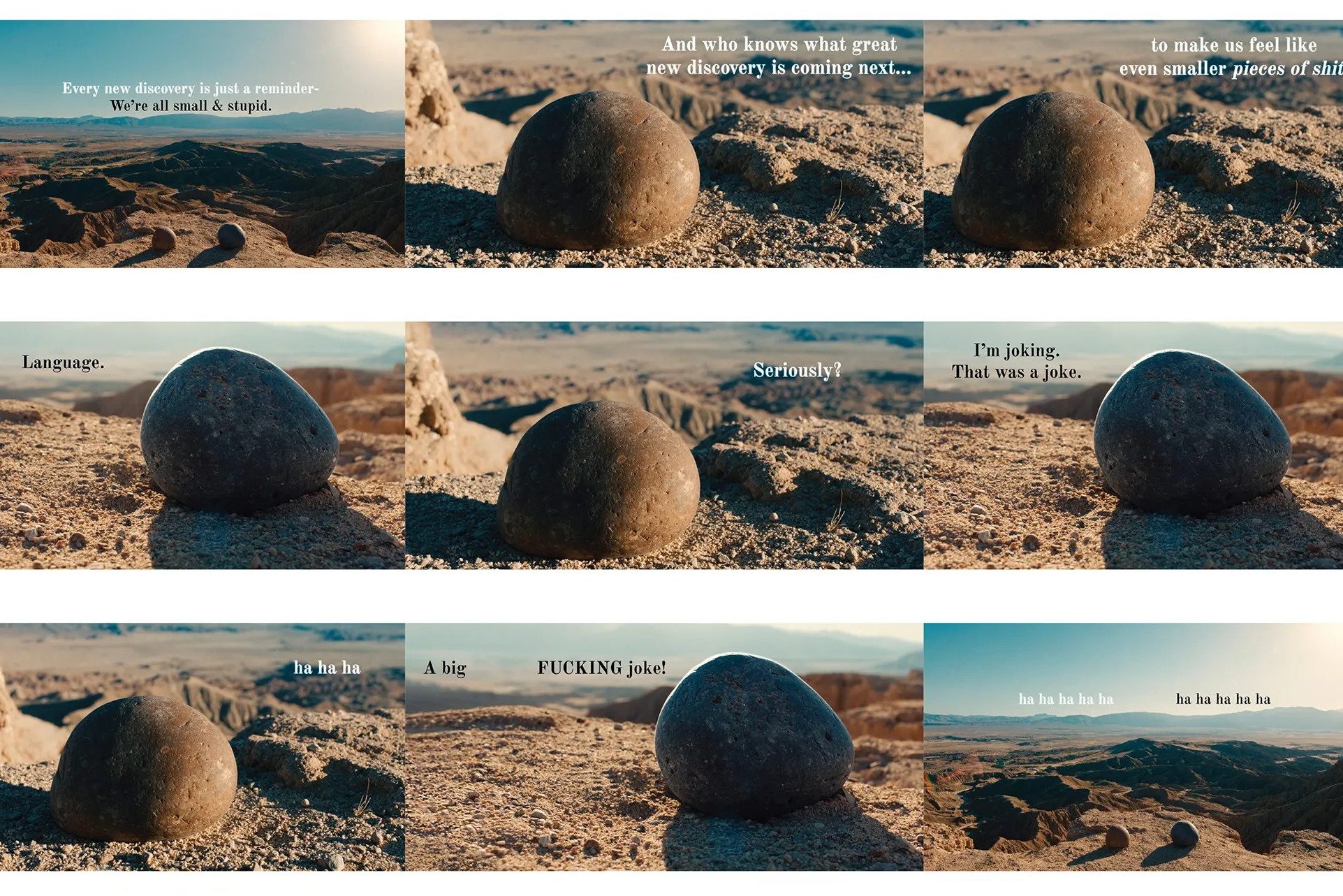
What if – We Were Rocks?

All the actors in her world remained, as it was her world, thus ours would have different influencers and actors to play out our story. She was in fact and would always be the hero of her own journey (ie messianic). The idea of enlightenment was explored by the husband she always wanted, but later realised why she married the man she did, namely to balance her initial fast thinking primary reaction (ref; Kahneman ‘Thinking fast and slow’) to fight like a dragon mother that Chinese women in their 40’s are often stereotyped as being. But this has nothing to do with the other characters, it’s purely her story with everything circulating around her, within her universe, everyone else is an actor responding to her decisions, reminds me of the hard to follow, but brilliant movie “Synecdoche, New York,” directed by Charlie Kaufman, an incredibly surreal journey into the life, times and draining disappointments of a playwright, who has the opportunity to write, direct, produce and star in his own play entirely about himself, gradually realising the futility of it all and life’s simple but often consequently devastating decisions, acted out before him.
Rent Control Paradox No 1

Featured

An outline of a strategy to address the commodified housing market. The idea originated from a thought experiment in 2018.

One of the first paradoxical issues surrounding Rent Control (RC) is the difficulty of implementing it, particularly because it would negatively impact the wealthy establishment the most. This often leads to a refusal to even consider the proposal.

This post is a response to a question I didn’t have time to address at the end of a presentation. I discussed the fundamental aspects of the current housing model and explained why unregulated private purchases and rents have become entirely market-driven due to the finalization of the mortgage debt market and the commodification of the living spaces we call home.

The question is an obvious first hurdle to even thinking about an introduction of private RC,

Slightly paraphrased question from my classmate Mark;


“How are you going to get an acceptance from small private landlords let alone institutions”?

My response stems from ideas I’ve been developing for a few years, inspired by a theoretical Beveridge 2.0 report. This includes addressing the “five giants” of a 21st-century neoliberal society in the UK.
It’s very broad, but the main point is how you convince people that the stick of RC will benefit the nervous middle (50-90 percentile) and suspicious asset wealth (top 10%).

Addressing bias

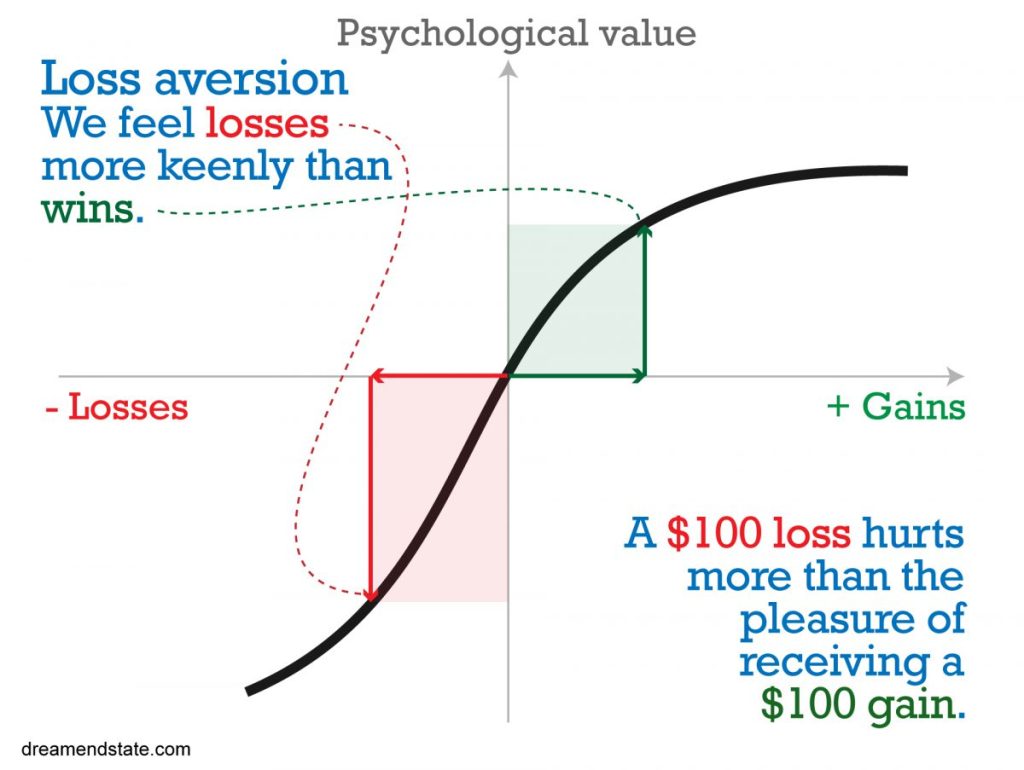
According to behavioural economist Daniel Kahneman, we tend to exhibit a stronger bias toward loss—known as “loss aversion”—than toward gain. This bias significantly influences our decision-making. Initially, it may seem beneficial to be overly cautious, as common sense suggests that careful consideration of financial decisions is wise. However, this tendency can lead to poor judgment in certain situations, as illustrated by gamblers who obsessively chase after their initial losses while ignoring the more rational option of accepting a loss and walking away (Kahneman, 2011). In contrast, an AI algorithm would evaluate the odds and would likely accept the initial loss if it determined that doing so was the best course of action for maximizing long-term gains. Humans, on the other hand, often struggle with this due to the emotional weight of the initial loss, often reacting with the fast thinking, emotion-led reactionary part of our decision-making dual apparatus ( the other being the slow rational side).

So, with this in mind, to counter the loss, we need a greater gain. Thus, in this report, I figured four carrots to the one stick. This is so important to creating societal jewels (i.e., the NHS) that can be justified to the majority over the small minority of self-seeking short-termists ( and we will see in the paper that all benefit long-term, again, the NHS).

Though it should be stated that any welfare fiscal spending cannot show a direct profit by its very nature, it’s once, twice, thrice removed. The measurement of GDP growth is only seen as a fiscal measurement of ‘production’ ( highlighted as the definition of production has been constantly manipulated; for example, only recently has rentier landlordism been included as a product, even though its extraction, nothing is actually created). The separation of generations cared for, educated from birth to grave, kept healthy, has food, shelter, warmth and no fear of retirement to concentrate on producing measurable wealth during the hours of productive employment.

Not all can be commodified for direct profit, but what can be produced unhindered by welfare concerns will be measurably more efficient in final output. A sick hungry workforce is absent in mind and body.


Concept

Using the Park to fill a need

Conceptual sketch of connection

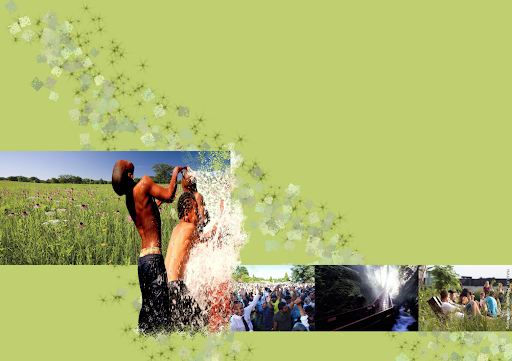
Mood Board

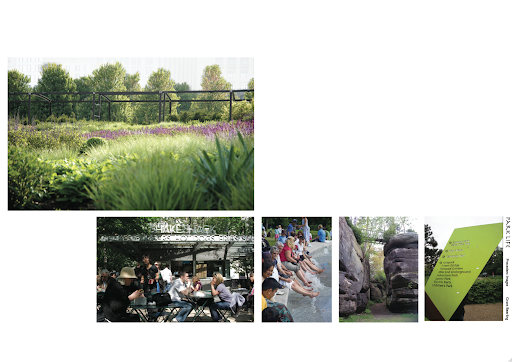
 Precedent Images

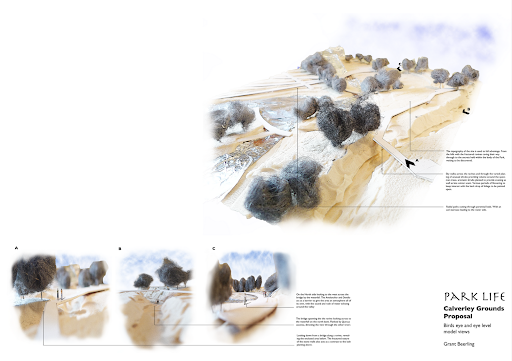
Model

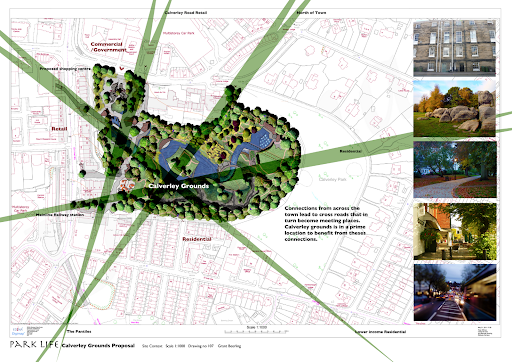
1;1000 plan

Using the Grounds to become a cross roads for desire lines (i.e.the shortest routes from A to B) that people will use. Connecting the various areas within TW, both past and present.
In particular the new shopping centre, with a bridge going directly (at an elevated level) to the park (with the bonus of underground parking being covered by the park). 
This allows for retail, in particular the lunch time crowd to gather at the upper part of the park (see below). Circulation is important for choices and uses of the space. So, a short term stay in the upper park or a longer more relaxed exploration of the grounds. A return visit to a memorable spot, a concert, a visit to the restaurant at the top of the grounds, ice skating in the winter with the bonus of a nice hot brew from the cafe.

Circulation Plan


So we have got the people in the park, now for them to move around, explore
and discover what the park has to offer.

A big issue with parks is the simplistic view of what they should be. Too many Councils still hold onto the old Victorian view of a place to parade on a Sunday.
A park must function within the context that it resides. So in this a case, the fact that its in the middle of a busy town. So easy access for the brief and regular visiting crowd of lunch timers. Therefore,  Provide food, somewhere to sit, to people watch (the most common sport in the world), to meet, (especially at a corner or a junction i.e. a place) and finally provide water, to watch and interact with.
None of this should be assumed to work, so the study below produced in 1980 in New York by the famous (or should be) Mr Holly Whyte will enlighten if the concept of place making is new to you. 

All Town Planners, Urban Designers, Landscape Architects and Architects must and should watch this before undertaking ANY Project concerning public space.

From a previous blog

Its about People………..Stupid

I have been going on about this study along with a book titled ‘A Visual Approach To Park Design’ by Albert J Rutledge. Chicago city started an organisation called ‘Project for Public spaces’ which was inspired by Fred Kent one of Whyte’s assistants on the project below.  A massive resource of idea’s that I wished I looked into further before compiling the document ( I skimmed the edges as lack of TIME like all of us). If i have a passion its making places that effect peoples lifes for the better on a daily basis. Which I realise Parks are one of them. Can you imagine Calverley becoming ‘A Place’ again? Sod the fancy stuff, get the basics right…..See below.
So here is the video in question. Made in 1980 (when most of you less than a twinkling in somebody’s eye ), but still relevant. Like good music if the quality is there then its timeless. Thus this research video. An hour long, but totally fascinating. Applies to both parks, the low traffic flow of TW thus need to attract, and the high traffic of Jubilee, need to retain.
I would be interested on your thoughts.
For me, it was the answer to the big question, Why should anybody visit my park, or to put it another way, how do I make my park ‘A Place’ rather than a field?
https://archive.org/embed/SmallUrbanSpaces

https://archive.org/details/SmallUrbanSpaces

On the third viewing (…sad I know) the point of ratio of human space. Too wide and the distance will not be to scale, and narrowness in not necessarily a deterrent. To finish, a quote from the great man himself,

“I end then in praise of small spaces. The multiplier effect is tremendous. It is not just the number of people using them, but the larger number who pass by and enjoy them vicariously, or even the larger number who feel better about the city center for knowledge of them. For a city, such places are priceless, whatever the cost. They are built of a set of basics and they are right in front of our noses. If we will look.” ‘William H.(Holly) Whyte (1917-1999)’

The Social Life of Small Urban Spaces, Washington, D.C.: The Conservation Foundation, 1980.

The Park

Within the Space

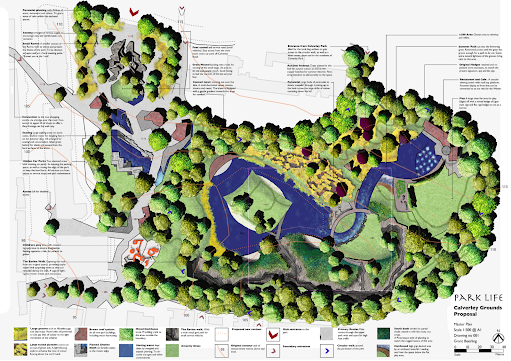
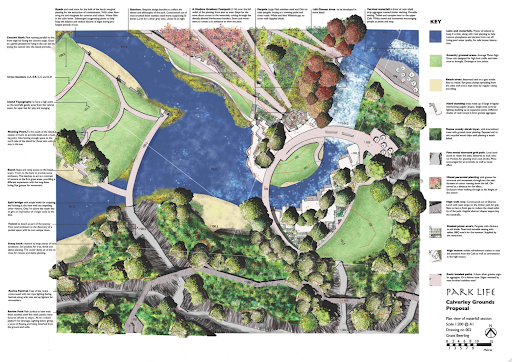
1:500 plan
Please click on the image to enlarge, due to A1 and Blogspot reducing the file size it is not as crisp an image as original, though can still be read….just.
Note: Covered car parks by the BBC studio, to bring extra height for the connecting bridge to the Station.
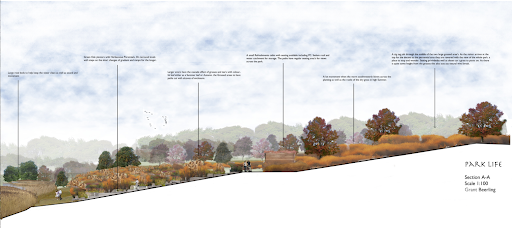
A Park with something for everyone visiting the Town. A venue for concerts, exploration, walking the dog, a run, to look in wonder at the water falls. To be seduced by the southern facing hillside with beautiful perennial planting designed by the head Gardener in conjunction with the local ‘Friends of the Park Society’. 
Local businesses to be involved as they will benefit from extra footfall traffic.
The upper area in particular to sponsored by the business that benefit, not just financially, but with input, thus adoption of the space.
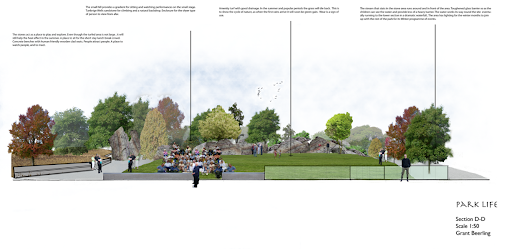
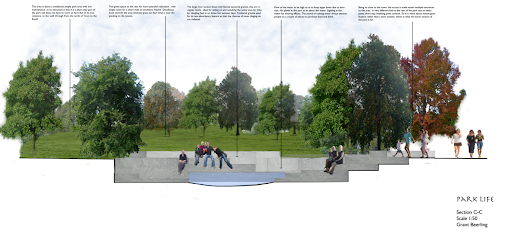
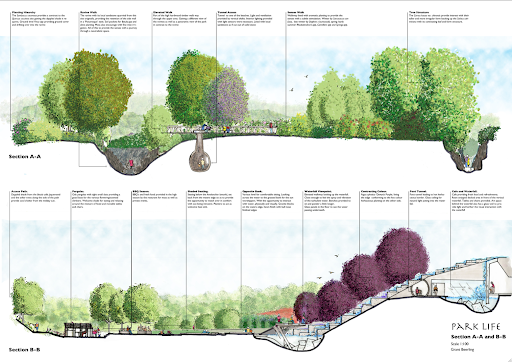
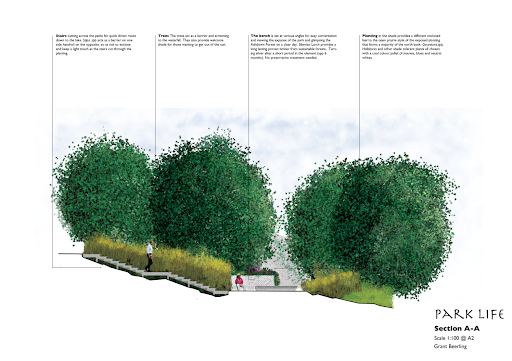
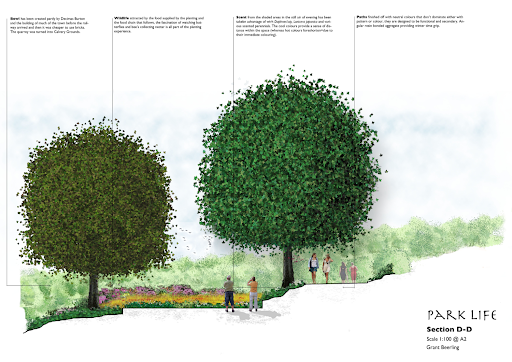
Upper area cross section
Lunch time concerts, plenty of places to sit, angled benches for easy conversation, Rocks to climb and move through. In context with the town and surrounding area. Open lawn for summer lounging.

Area backing onto the high street (i.e. parallel ).With water to paddle, dangle feet in during the summer. Seating steps to the water side.


Lower Area

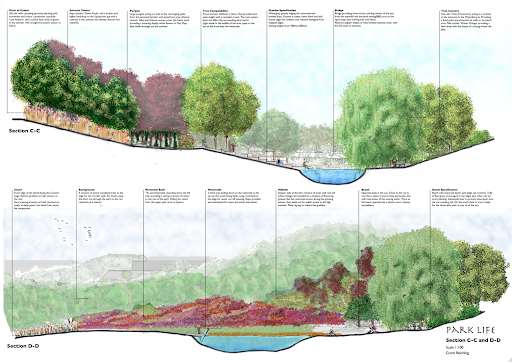
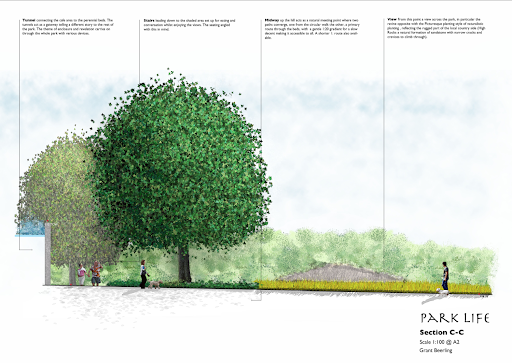
Cross section of the southern facing perennial planting, going down to the waterside.
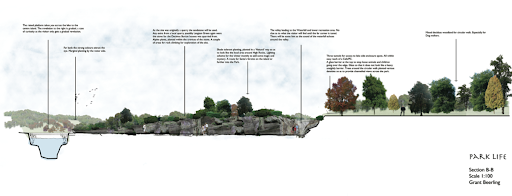
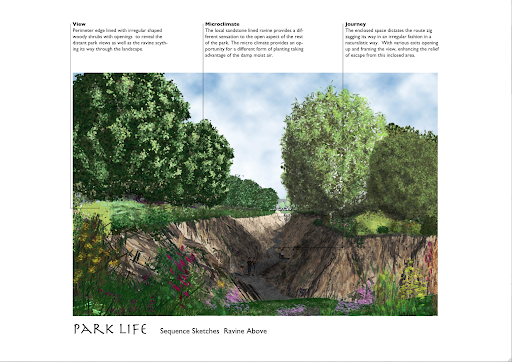
The valleys of rock to explore, providing framed and surprising views across the park

A Closer Look

Plenty of options

1:200
A closer look at the Valley, Waterfall, Island, and Perennial area.


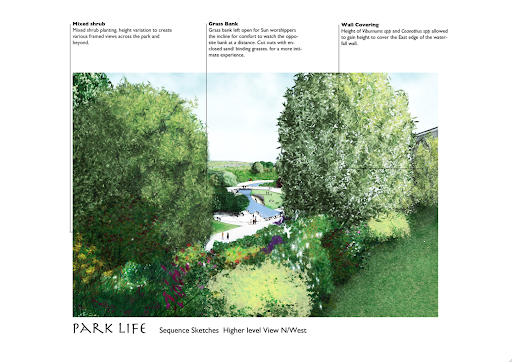
Through the valleys and tunnel to an enclosed beach. High top viewing through the mixed planting. Looking up the waterfall, large area for summer entertainment/BBQ’s. 

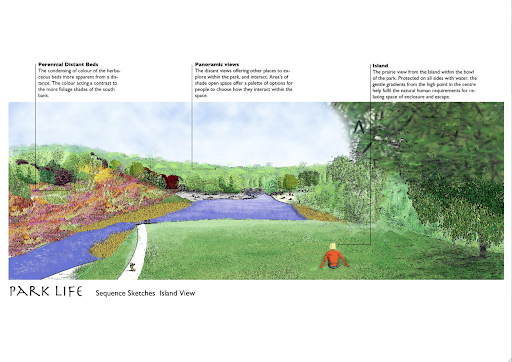
Looking across the Perennial Beds with a density of trees to feel the sense of enclosure within the space.

Night

Night Garden
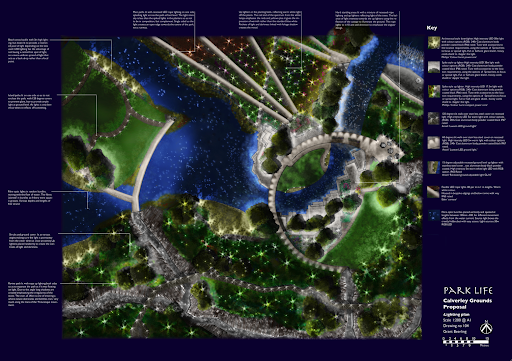
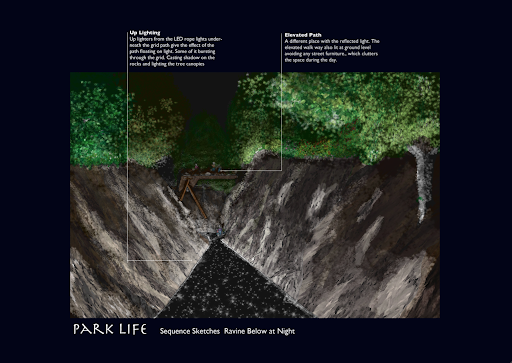
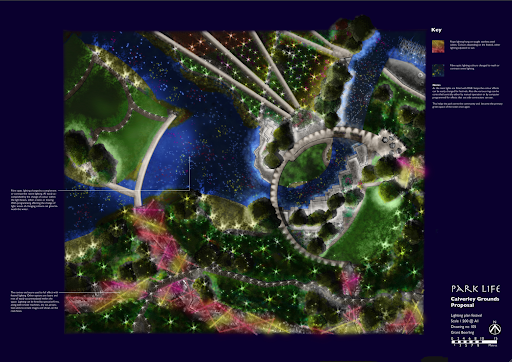
At night the atmosphere can be manipulated with lighting to create another space to be used and explored.

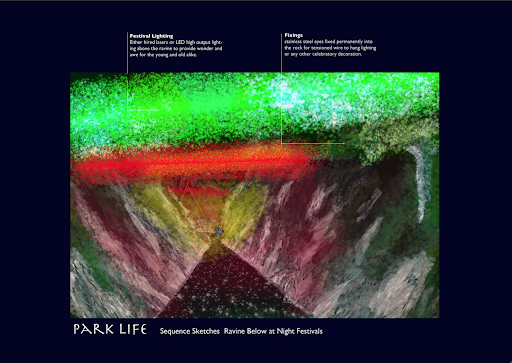
Uplighter’s in the valleys create a new space of reflected light and shadow.
Various times throughout the year can have addition hired lighting for concerts, Christmas and other celebrations. Lighting has been used to great effect at Bedgebury for Christmas.

A tunnel of wonder for the young at heart. Maybe a bit of chintz, but this is about the many not the few. Thus what may seem a ‘bit tacky’ to some will also produce wonder to the young imaginative mind and create a memory of place that will live forever from those formative years. After all its not about the designer, but the end user. 

Walkabout

Sequential sketches
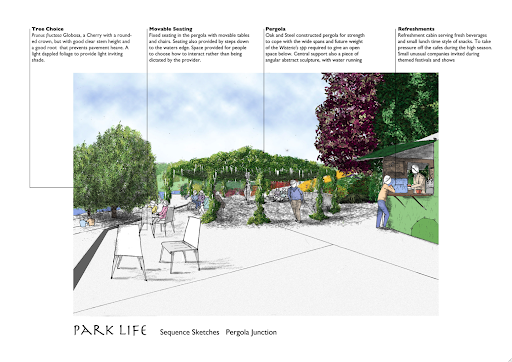
A central meeting point for a coffee, note, the famous moveable chairs from Holly Whyte philosophy of place. 

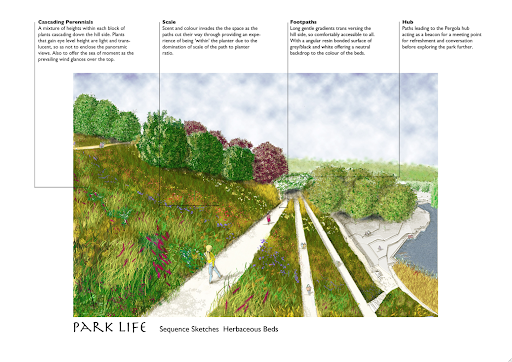
A walk through the perennial beds to the central Pergola. Note: Zig-zag for shallow gradients, stairs for desire lines. Both providing answers for the steep gradient and using it as a benefit rather than a problem.

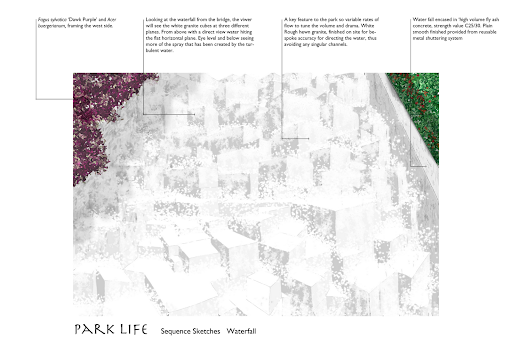
Looking down from height to the lower section of the main waterfall.


Looking to the East from the Island.


Looking up the huge waterfall.


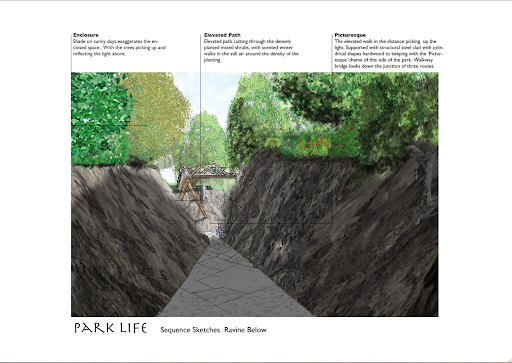
Above the valley looking to the distant bridge.


In the Valley, enclosed journeying towards the revelation of a framed view. Note, elevated walkway through the dense shrubs/woodland. 

Closer Still

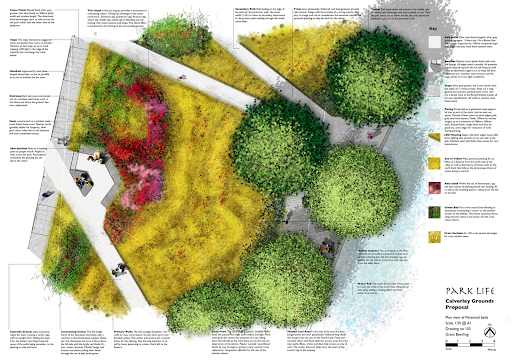
A River of plants

1:50
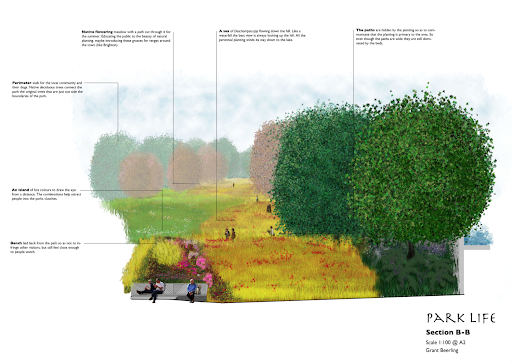
Sways of planting in an informal manner. Benches at junctions for meeting and conversation. Direct and indirect routes, you choose.

Obama on a short visit for some thinking time.


On the ridge looking to the North Bank.
A time to sit and ponder, or grab a snack, enclosed within beautiful planting.

Looking to the West back to the high street.