Unveiling the Truth about Rent Control and Land Values in Housing

Featured

Further analysis of where Vicky didn’t go!

A great interview with Housing journalist and author

My comments on the interview and replies to other’s comments are in parts two and three.

I’ve been researching housing unaffordability for seven years and am about to start writing a dissertation on Rent Control (℅ Dr Anna Minton). After all these years of trying to find solutions, the elephant in the room is Rent Control. Why?

This is a disappointing and slightly dull answer, but it’s one of the keys that has unlocked many doors for working—and middle-class people who don’t want to spend 30-50% of their income on a 40-year mortgage or rent to a landlord.

Some of the main authors to thank for this conclusion are John Doling (tries to be neutral), Danny Dorling (left), Nick Bano (left), Kemp (right), and Christine Whitehead (LSE, right). It is always good to see if there is a counter-argument of value—there isn’t.
(As well as Smith, Ricardo, Marx, Keynes, Piketty, Blyth, Mazzucato, Christophers, Kelton, Richard Murry and Minton)

Her Book, Tenants

Why? An example: I’m a former bricklayer who ran a business in construction, so I know about house building pricing. My humble little flat;
In 1994, it was purchased for £47,700 with a floor area of 42m². In 1994, it cost £600 per m² to build, thus £25,200 to rebuild. Therefore, 53% build/47% land value = £47,700.

The killer point: in the 1950s, land values of new builds dropped to 3%. Based on those values and present-day build values (£2K per/m²), my flat would be on the market for £86,600, which equates to 2.4 times the full-time national average income (£35K). 2.4 times was also needed in the 1950s-60s for a single average income to buy an average 2.5-bed semi (.5 being the box room).

Ref; The Housing Crisis is Even Worse Than You Think | Aaron Bastani meets Vicky Spratt | Downstream

At present I’m working on a paper that will be finished by the 26th of April, once completed I will write a timeline for the Video filling in the areas that some may want more information on. As well as the Buy-To-Let Quetion that was left unanswered.

Post 26th I’ll have more info as the area I’m working on is the periods of; 1930-42, 1945-70, followed by 1979 to the present concerning universalist approach to housing/welfare until 1979 then the selectivist approach to housing/welfare.

Keynes; The role of Government is to create a society where all can have the opportunity to have a ‘good life’ and not just the few.

What actually is the point of the Private Rental Sector (PRS)?

The Housing Act of 1988 deregulated new lettings to encourage the PRS to return, 44 years later the potential for 1910 rent strikes of pre The Rent Control Act of 1914 look like they may return.

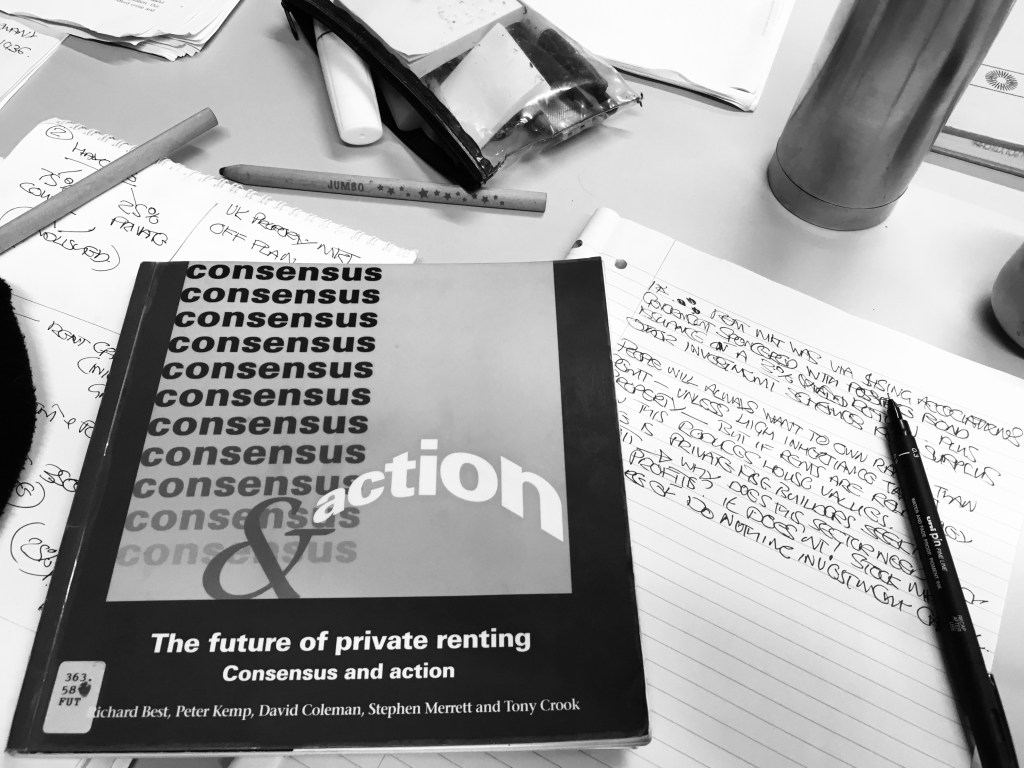
Sitting in the library, grinding my way through various papers and journals on Rent Control (RC), I started to read a report from the much admired Joseph Rowntree Foundation (JRF) published in 1992 with various academic, housing pressure groups, practitioners and financiers together with advisors to politicians from different parties all contributing to the discussion. So far so good, but…..

The book in question amongst my usual chaos

Two issues of cognitive bias became increasingly apparent, both of which we all suffer from as emotional beings, so I’m not specifically criticising the authors of the report, but taking the more cautious route of an anthropologists like, the sadly departed David Graeber and also the political economist Thomas Piketty. Graeber in his book (and the secret is in the title) Debt; The First 5000 years and Piketty to a lesser extent focussed on the past 200 years in his highly acclaimed and fascinating book Capital of the 21st Century.

Recency bias is a cognitive bias that favors recent events over historic ones

The first bias was the effect of just looking to the lived and experienced recent past (recency bias) and making a judgment that a correlation of rent controls of the recent past have meant that the PRS has reduced due to not enough yield being available from old RC properties, that is a fair judgment, but does that mean that to get more rented properties available for the small sector (at the time of the report) of transient renters, namely young people on their way to purchase and temporary work force ( in fact a red herring) moving around the country, you just simply reverse the model?

So with that logic, if rent control causes PRS shortages then abandon rent control and supplement the PRS and a ‘fair’ rental market will return with the benefit of landlords now also getting a ‘fair return’.

What could possibly go wrong’?

The issue with this decision is that now in 2022 we are seeing the true consequences of this reversal, rather than market rates settling to a ‘fair rent’ level they are driving people into cohabitation and single room conversions with shared bathrooms as incomes have stagnated (not so much trickle down, but rather, trickle up), but rents increase as scarcity within the ‘free market’ predicts.

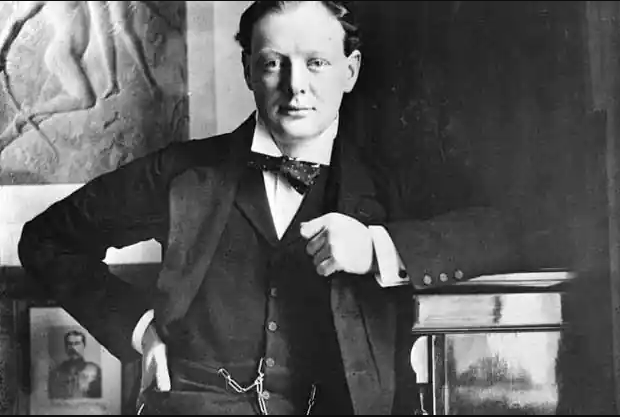
Whereas if they had taken the time and effort to look back to pre 1914 Rent Act they would’ve seen the issues of free market rents gradually consuming and therefore monopolising a sector that even Winston Churchill in 1909 fumed and rallied against to the greed and slothfulness of the rentier class.

Churchill in his mid thirties around 1909

Rent Control Paradox No 1

Featured

An outline of a strategy to address the commodified housing market. The idea originated from a thought experiment in 2018.

One of the first paradoxical issues surrounding Rent Control (RC) is the difficulty of implementing it, particularly because it would negatively impact the wealthy establishment the most. This often leads to a refusal to even consider the proposal.

This post is a response to a question I didn’t have time to address at the end of a presentation. I discussed the fundamental aspects of the current housing model and explained why unregulated private purchases and rents have become entirely market-driven due to the finalization of the mortgage debt market and the commodification of the living spaces we call home.

The question is an obvious first hurdle to even thinking about an introduction of private RC,

Slightly paraphrased question from my classmate Mark;


“How are you going to get an acceptance from small private landlords let alone institutions”?

My response stems from ideas I’ve been developing for a few years, inspired by a theoretical Beveridge 2.0 report. This includes addressing the “five giants” of a 21st-century neoliberal society in the UK.
It’s very broad, but the main point is how you convince people that the stick of RC will benefit the nervous middle (50-90 percentile) and suspicious asset wealth (top 10%).

Addressing bias

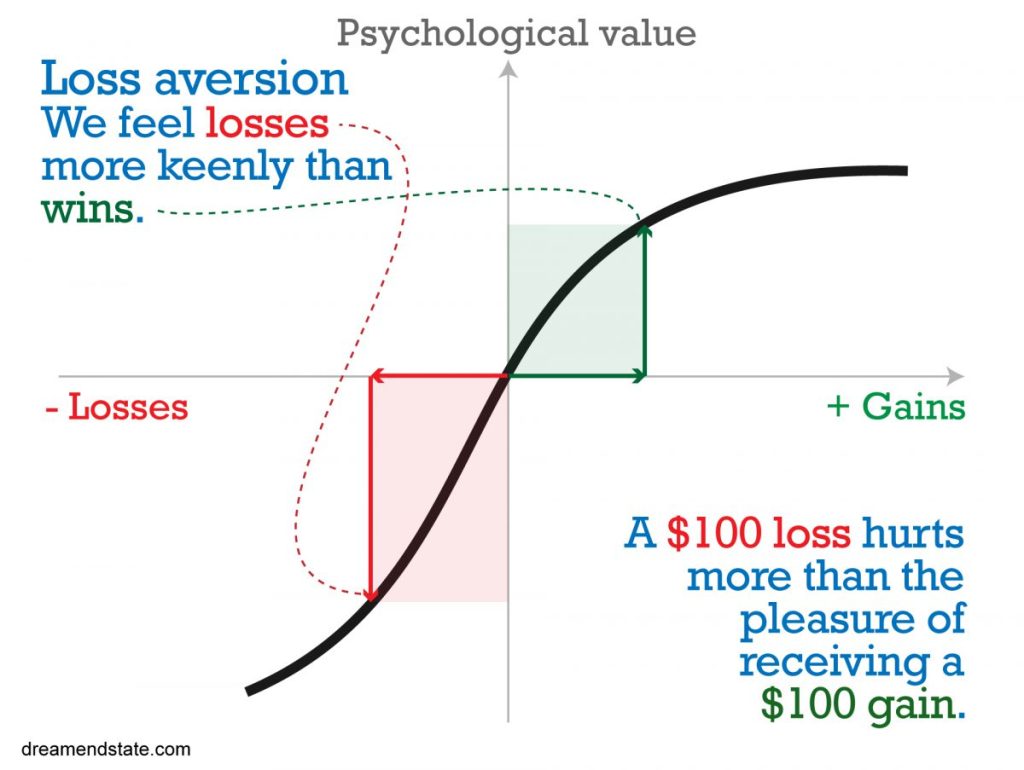
According to behavioural economist Daniel Kahneman, we tend to exhibit a stronger bias toward loss—known as “loss aversion”—than toward gain. This bias significantly influences our decision-making. Initially, it may seem beneficial to be overly cautious, as common sense suggests that careful consideration of financial decisions is wise. However, this tendency can lead to poor judgment in certain situations, as illustrated by gamblers who obsessively chase after their initial losses while ignoring the more rational option of accepting a loss and walking away (Kahneman, 2011). In contrast, an AI algorithm would evaluate the odds and would likely accept the initial loss if it determined that doing so was the best course of action for maximizing long-term gains. Humans, on the other hand, often struggle with this due to the emotional weight of the initial loss, often reacting with the fast thinking, emotion-led reactionary part of our decision-making dual apparatus ( the other being the slow rational side).

So, with this in mind, to counter the loss, we need a greater gain. Thus, in this report, I figured four carrots to the one stick. This is so important to creating societal jewels (i.e., the NHS) that can be justified to the majority over the small minority of self-seeking short-termists ( and we will see in the paper that all benefit long-term, again, the NHS).

Though it should be stated that any welfare fiscal spending cannot show a direct profit by its very nature, it’s once, twice, thrice removed. The measurement of GDP growth is only seen as a fiscal measurement of ‘production’ ( highlighted as the definition of production has been constantly manipulated; for example, only recently has rentier landlordism been included as a product, even though its extraction, nothing is actually created). The separation of generations cared for, educated from birth to grave, kept healthy, has food, shelter, warmth and no fear of retirement to concentrate on producing measurable wealth during the hours of productive employment.

Not all can be commodified for direct profit, but what can be produced unhindered by welfare concerns will be measurably more efficient in final output. A sick hungry workforce is absent in mind and body.


Próblēma, “anything thrown forward,

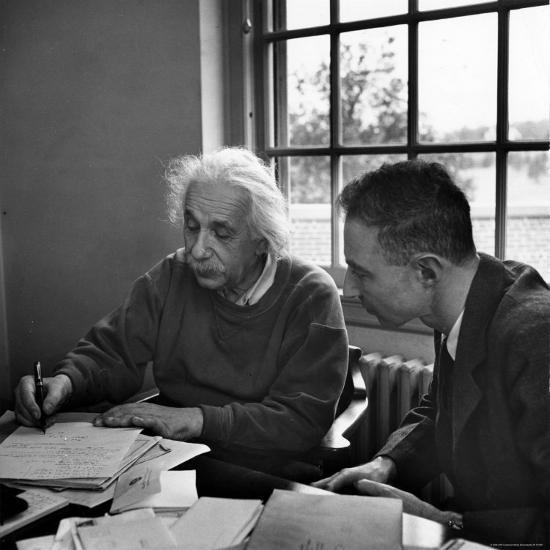
Albert solving some problems, or so it looks.

Why we need problems.

Recently watched a Vpro ( documentary maker from the Netherlands) documentary. Highlighting the issue of University inventions and thus patents being given away free to private industry to use and then profit from, with the bizarre reality of the state buying them back including a rent for the patent! Think pharmaceuticals and the NHS.

The well known and often quoted is the iphone, most of the internal components were government funded projects for defence, navigation and general public funded university research, all used by Steve Jobs and co, and cleverly put together to create the ubiquitous smartphone which was then marketed for huge profits, with none going back to the publicly funded organisations as if it was all the ideas of just the private sector (remember these corporations also avoid taxation).

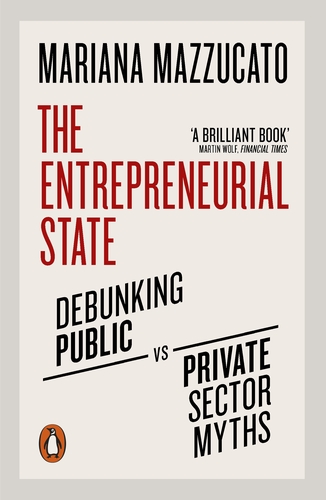
So Mariana Mazzucato goes through this in her book The Entrepreneurial State (debunking public v private sector myths, video further down the page) and the Vpro video.


One section near the end caught my imagination.
Problems are there to be solved, the Kennedy moonshot speech;


We choose to go to the Moon. We choose to go to the Moon… We choose to go to the Moon in this decade and do the other things, not because they are easy, but because they are hard; because that goal will serve to organize and measure the best of our energies and skills, because that challenge is one that we are willing to accept, one we are unwilling to postpone, and one we intend to win, and the others, too”.