
2) So, OK – end of the private rental sector in about two years under your plan – two years, not 30 years. Also, a complete end to build-to-let, which is a massive knock on the housing supply too. Wouldn’t it be simpler just to ban everything instead of pretending to allow it?

History shows that land values fell over a period of 50 years (1900 to 1950), partly due to the early 20th-century recession, then declined further from 1915 to the 1950s. It will not be two years (note the ERM crisis of 1992; it took at least three years for the value to drop 20%). I already stated that housing is an illiquid asset (i.e., difficult to exchange for liquid cash).
You are going to hate this. We have a similar amount of housing per capita to the 1970-90s, when it was considered that we were close to having enough, but still needed to clear more Victorian slums.
So what’s the difference? 1991: <9% PRS; now 19%, which equates to an additional 2.8 million properties behind the PRS-free-market rents (i.e., 10%). When the PRS leave, the property doesn’t suddenly disappear. In the 1920s, 1 million properties were purchased by sitting tenants, the PRS, who wanted to get out quickly before they lost any more money. This continued until the early 1990s.
Also, there was a scheme for local authorities to purchase former PRS and turn them into social housing.
There is a place for PRS, and there was when I was in the market for a property purchase in the late 1980s. Everyone I knew who rented privately did so as a stopover before purchasing a property, as rents were relatively (by today’s standards) cheap, there was still a lot of social housing keeping rent values down, and no ‘Buy-To-Let mortgages’ (they came in 1996). Also, for people travelling and working around the country as temporary residents, the fear was NOT having any PRS in the early 1990s.
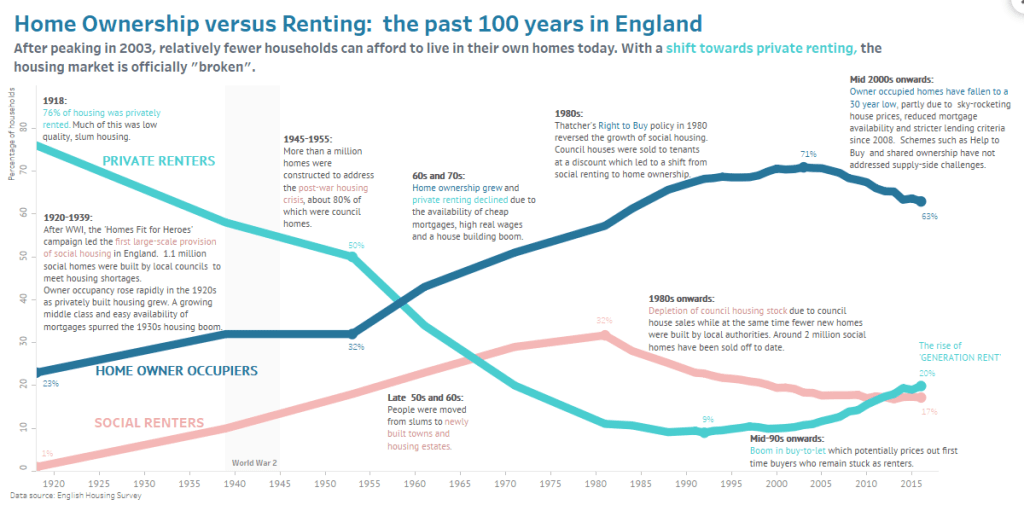
8-10% seems about the right amount for this purpose.
Side note: I also worked as a building contractor for a large landlord, maintaining and updating his properties in the 1980s. He was a good landlord; many of his tenants were still under rent control. He lived in a nice, detached house, wealthy but not obscene.
My Grandfather, who owned a medium-sized construction company (1940s-1980s), also owned rental properties. Landlordism wasn’t really a profitable sector compared with others; for my Pentecostal grandfather, it was more about charity for the elderly.

